Mastering the Basics: Training Your Bloodhound for Obedience Success
A bloodhound has roughly 300 million scent receptors, compared to about 5 million in a human, and that nose will override your “sit” the moment a squirrel that crossed the yard three hours ago leaves its trail. Most owners blame stubbornness and give up by month six. The truth is simpler: you are competing with the most powerful scent machine in the dog world, and you need a plan built for it. This guide to mastering the basics: training your bloodhound for obedience success gives you that plan, with exact steps, timelines, and fixes for the problems you will hit.
Why Bloodhounds Train Differently Than Labs or Shepherds
Bloodhounds were bred for one job: following a scent trail for miles and committing to it, whatever the handler wanted. Breeders prized independence and persistence over eagerness to please. That is why a Labrador might learn “sit” in three repetitions while your bloodhound looks at you, looks at the floor, and starts sniffing the carpet.
This is not low intelligence. Bloodhounds are problem solvers. They simply ask, “What is in it for me?” before they comply, and the answer has to beat whatever their nose just found.
The Numbers That Shape Your Training Plan
- Size: Adult males weigh 90 to 110 pounds and stand 25 to 27 inches at the shoulder; females run 80 to 100 pounds. A pulling adult is a real safety issue, so leash skills matter early.
- Maturity: Bloodhounds mature slowly, often not settling until 2 to 3 years old. Expect adolescent selective hearing from about 6 to 18 months.
- Attention span: Plan on 5 to 10 minute sessions for puppies and 10 to 15 minutes for adults. Longer sessions produce sniffing and shutdown, not learning.
Your strategy follows from this: short sessions, high-value rewards, and controlled environments where scent distractions are low. Work with the nose, not against it.
The 5 Tools You Need Before Day One (and What They Cost)
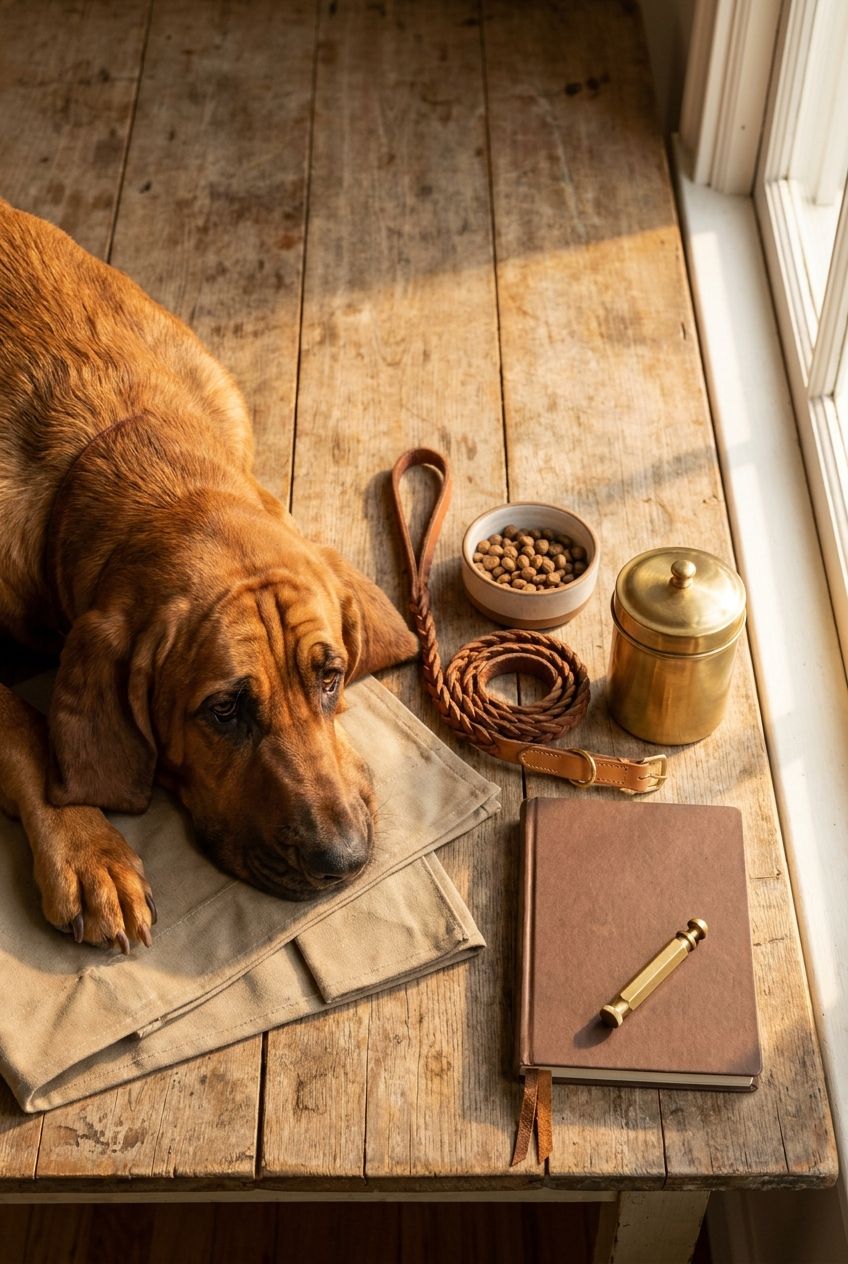
The wrong gear sabotages bloodhound training faster than any behavior problem. A flat collar on a dog that lunges after scents puts pressure on the trachea (windpipe), and a flimsy leash snaps under 100 pounds of determination. Buy these first.
- Front-clip harness ($30-$45): The Blue-9 Balance Harness or Ruffwear Front Range clips at the chest, so pulling turns the dog toward you instead of rewarding the lunge.
- 6-foot leather or biothane leash ($20-$35): Skip retractable leashes entirely. They teach pulling and offer zero control when a scent hits.
- 30-foot long line ($15-$25): Biothane, a coated webbing, resists mud and water. This is your recall safety net and your scent-freedom tool.
- High-value treats ($10-$15 per bag): Freeze-dried liver, Zuke’s Mini Naturals, or small cubes of cooked chicken. Pea-sized pieces only, because you will deliver 50 to 100 rewards per session.
- Treat pouch ($10-$15): Fast reward timing matters. If you fumble in a pocket, the moment is gone.
Total startup cost: roughly $90 to $135. But what if your budget is tight? Buy the front-clip harness and the long line first. Use chopped hot dogs for treats at about $3 a pack, and add the rest later.
How to Teach Sit, Down, and Stay in Under 10 Minutes a Day
Start in your quietest room, with the TV off and no food smells drifting from the kitchen. Train before meals, when your dog is hungry, and keep sessions under 10 minutes.
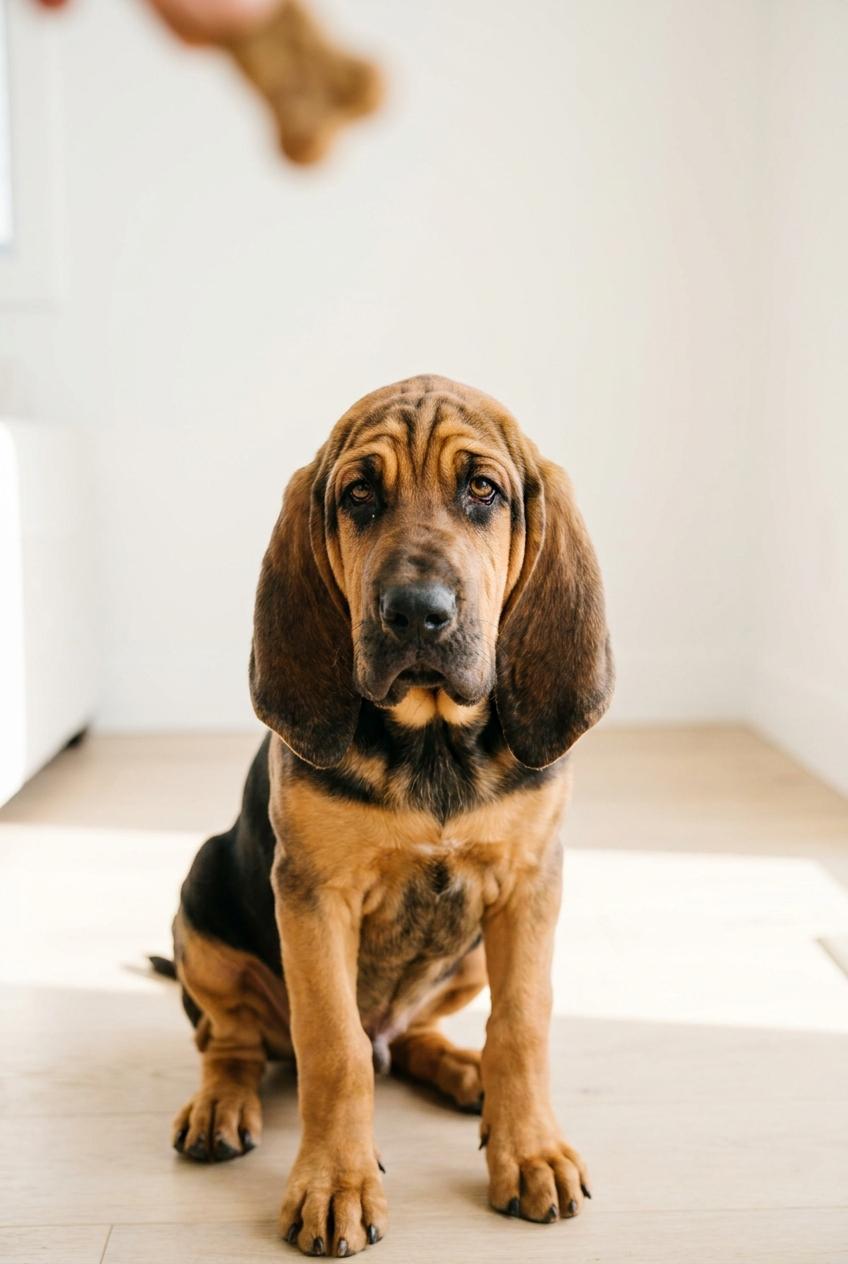
Teaching Sit: The Lure Method
- Hold a treat at the nose and let your dog sniff it. Success: the nose is locked on your hand.
- Slowly raise the treat over the head toward the back of the skull. The rear naturally drops. Success: the bottom touches the floor.
- Mark and reward the instant the bottom lands, saying “Yes!” then delivering the treat. Do 10 repetitions.
- Add the word “sit” only after your dog sits reliably on the lure, usually by day 3 or 4.
But what if your bloodhound backs up instead of sitting? Practice with their back near a wall or couch so there is nowhere to retreat.
Teaching Down and Stay
From a sit, lower a treat straight to the floor between the front paws, then slide it forward along the ground. Most bloodhounds fold into a down within 5 to 15 attempts. For stay, start with just one second of holding position before rewarding, then add one second at a time. Reaching 10 seconds usually takes a week of daily practice; reaching 30 seconds with you moving away takes three to four weeks.
Expect progress to look slow. A bloodhound that sits on cue in the living room within a week has done well. Reliable obedience in the backyard comes later.
Leash Training a 100-Pound Nose: The Stop-and-Go Method
Bloodhounds do not pull because they are dominant. They pull because forward movement gets them closer to the smell. Your job is to make pulling stop working, and make walking beside you pay.
The Step-by-Step Fix
- Gear up: Front-clip harness and a 6-foot leash. Carry 20 pea-sized treats.
- Stop the instant the leash tightens. Stand still like a tree. Success: your dog looks back or the leash goes slack.
- Reward the slack leash with a treat at your thigh, then walk on.
- Repeat constantly. A 10-minute walk may cover only 50 yards the first week. That is normal.
- Add a scent break reward: After 10 good steps, say “Go sniff!” and release your dog to investigate a smell for 15 seconds.
That last step is the secret. Sniffing is the reward your dog wants most, so use it as currency. A bloodhound that knows loose-leash walking earns sniff time will cooperate far more than one denied sniffing altogether.
But what if your dog drags you to a scent anyway? Turn and walk the opposite direction without a word, then reward when the leash relaxes. Never yank. Consistency across 3 to 4 weeks typically cuts pulling by more than half.
Recall Training: Why Off-Leash Is Rarely Safe (and What to Do Instead)
Here is the unpopular truth: a bloodhound on a scent trail may not hear you at all. Many experienced owners and breed clubs recommend that bloodhounds never be off-leash in unfenced areas, because the dog can follow a trail for miles and cross roads without a glance back.
That does not mean recall is pointless. A solid recall on a long line is still a vital skill, and it works in fenced yards where mistakes are cheap.
Building a Reliable Recall in 6 Weeks
- Weeks 1-2: Say “Come!” in an excited voice from 5 feet away indoors. Reward with 3 treats in a row, jackpot style.
- Weeks 3-4: Move to the fenced yard on a 30-foot long line. Call once, reward generously, release back to play.
- Weeks 5-6: Add mild distractions, like a toy on the ground, still on the long line.
Never call your dog to end the fun or to scold. If “come” ever predicts something unpleasant, a bloodhound will remember. Instead, make coming back the best part of the walk. For true off-leash freedom, use enclosed dog parks or a securely fenced acre, not open fields.
Crate and Potty Training Timelines That Work for Bloodhound Puppies
Bloodhound puppies have the same small bladders as other breeds, but they get distracted by every smell on the way to the right spot. Structure beats hope.
The Schedule
| Puppy Age | Max Time Between Potty Breaks | Crate Time Limit |
|---|---|---|
| 8-10 weeks | 1-2 hours | 1-2 hours |
| 3-4 months | 3 hours | 3 hours |
| 5-6 months | 4 hours | 4 hours |
| 6+ months | 5-6 hours | 5-6 hours |
Take your puppy out immediately after waking, eating, drinking, and playing. Use one consistent spot and a cue like “Go potty.” Reward within 3 seconds of finishing, in the yard, not after you return indoors.
For the crate, a 42-inch wire crate (about $60-$90) fits an adult bloodhound, with a divider to shrink it for the puppy. Feed meals inside the crate with the door open, then closed for 5 minutes, building up. Most puppies accept the crate within 2 weeks. But what if your puppy howls all night? Bloodhounds are vocal. Place the crate beside your bed for the first 2 weeks, ignore howling that lasts under 5 minutes, and take them out only if they genuinely need a potty break.
Which Training Method Fits Your Bloodhound? A Side-by-Side Comparison
| Method | Speed of Results | Cost | Best For | Recommendation |
|---|---|---|---|---|
| Self-training at home with treats | Moderate (3-6 months for basics) | $100-$150 in gear | Owners with daily time and patience | Best for first-time owners on a budget |
| Group puppy class (6-8 weeks) | Moderate, plus socialization | $120-$250 total | Puppies 10-20 weeks old | Best for socialization and structure |
| Private trainer (6 sessions) | Fast, tailored fixes | $300-$900 | Pulling, reactivity, or tight schedules | Best for specific problem behaviors |
| Board-and-train (2-4 weeks) | Fast but may not transfer home | $1,500-$4,000 | Owners who cannot train daily | Only worth it with a trainer who teaches you too |
For most households, the winning combination is a group class for socialization plus daily home practice. Add a private session or two only if a specific problem refuses to budge. Look for trainers certified through CCPDT or the Karen Pryor Academy who use reward-based methods, because harsh corrections tend to shut bloodhounds down rather than motivate them.
5 Common Bloodhound Training Mistakes and How to Fix Each One
- Repeating commands. Saying “sit, sit, SIT” teaches your dog that the first two cues are optional. Say it once, wait 3 to 5 seconds, then guide the dog into position with a lure and try again.
- Training too long. Sessions beyond 15 minutes produce a sniffing, disengaged dog. Stop while your bloodhound is still succeeding, even if that means 3 minutes.
- Using boring rewards. Kibble loses to a fox scent every time. Rotate high-value treats and save the best ones, like warm chicken, for outdoors and recall.
- Skipping socialization. The key window is 3 to 14 weeks old. Expose your puppy to 50 different people, surfaces, and sounds before 16 weeks, safely and with treats attached to each new experience.
- Punishing the howl or the nose. Bloodhounds howl, bay, and sniff by design. Instead of suppressing it, give them outlets: a daily sniffing walk and a scent game, which brings us to the next section.
Using the Nose as Your Training Partner: Scent Games That Build Obedience
The fastest way to improve a bloodhound’s focus is to give the nose a legitimate job. A dog that has burned mental energy on scent work is calmer and more cooperative in every other lesson.
Three Games to Start This Week
- Find the treat: Have your dog stay (or have a helper hold the leash), then hide 5 treats around one room. Say “Find it!” and let your dog work. Success: all 5 found in under 3 minutes.
- Muffin tin game: Place treats in 6 cups of a muffin tin and cover each with a tennis ball. The dog must remove balls to get the rewards. It takes 5 minutes and costs almost nothing.
- Scent trail in the yard: Drag a hot dog on a string along a 30-foot path ending at a hidden bowl of treats. Let your dog follow the trail on a long line. Increase length by 15 feet each week.
Ten minutes of scent work tires a bloodhound as much as a 30-minute walk. Many owners also explore AKC Scent Work classes, where trials are open to dogs from age 6 months and titles are earned through simple searches. Use scent games as a reward for obedience, too: “sit, stay, then find it!” turns self-control into the most fun part of the day.
What If Your Bloodhound Still Won’t Listen? Answers to the Toughest Objections
“My dog just ignores me outside.”
This is the most common complaint, and it is a training-level issue, not defiance. Outdoors, scent competes with you. Go back one step: practice in a quieter location, use better treats, and shorten the distance from you. Raise difficulty only when your dog succeeds 8 out of 10 times.
“My bloodhound is 2 years old. Is it too late?”
No. Adult dogs learn just fine. You will need more repetitions to overwrite established habits, usually 4 to 8 weeks of daily practice to see a major shift, but progress is absolutely possible.
“Do I need to be harsh because of their size?”
Harsh methods backfire with this breed. Bloodhounds are sensitive and can shut down or become evasive under pressure. A firm, calm voice and consistent boundaries work far better than corrections.
“They drool and howl. Can training fix that?”
Training will not stop the drool, which is anatomy, so keep a towel handy. Howling can be managed by meeting exercise and mental needs and rewarding quiet moments, but expect some baying forever. It is part of the breed’s charm and its job description.
“When should I call a professional?”
If you see growling, snapping, or resource guarding, book a certified behavior consultant right away. Also seek help if your dog is not responding after 8 weeks of consistent, correct training.
Your First 7 Days: Do This Tonight
Do not wait for the perfect plan. Tonight, grab 20 pea-sized treats, walk to the quietest room in your house, and set a timer for 5 minutes. Teach one thing only: sit using the lure method described above. When your bloodhound sits on the lure 8 times in a row, stop, praise, and let them go find a hidden treat as a reward. Repeat tomorrow, add “down” on day three, and book a puppy or basic obedience class this week. Ten focused minutes a day beats an hour on weekends, and a bloodhound that learns that listening unlocks the next great smell will follow you anywhere.