Mastering Dalmatian Obedience: The Ultimate Training Guide
Dalmatians were bred to trot for 20 to 30 miles beside horse-drawn carriages, which means the 55-pound dog on your couch has the stamina of a marathoner and the focus of a toddler with a drum kit. Most owners lose the obedience battle in the first six months because they train a Dalmatian like a Labrador. This guide to mastering Dalmatian obedience gives you the exact schedules, tools, and fixes that work for this athletic, sensitive, and famously strong-willed breed.
Why Dalmatians Test Your Patience (And How to Use It)
A Dalmatian is not stubborn out of spite. The breed was developed to run alongside carriages and guard horses, so it carries two built-in drives: relentless movement and independent decision-making. When you understand that wiring, training stops feeling like a fight.

The Traits That Shape Every Training Session
Dalmatians are sensitive, meaning harsh corrections shut them down or make them sullen for hours. They are food-motivated but easily bored, so a dull drill of 15 identical sits will lose them by repetition number six. They are also social and hate isolation, which fuels destructive behavior when left alone for more than 4 to 5 hours.
The Energy Math You Cannot Skip
An adult Dalmatian needs 60 to 90 minutes of real exercise daily, split into at least two sessions. A tired Dalmatian is a trainable Dalmatian. A leash stroll around the block does not count; think off-leash fetch in a fenced area, jogging, or hiking.
Here is the rule I give every new owner: exercise first, train second. Spend 20 minutes burning off the first wave of energy, then run your 10-minute training session. The same dog that ignored you at full tilt will hang on every cue when the edge is off.
But what if you work long hours? Hire a dog walker for a midday 30-minute run (typically $20 to $30 per walk in most US cities) or use a doggy daycare 2 to 3 days a week. Obedience gains evaporate when the dog’s energy has nowhere to go.
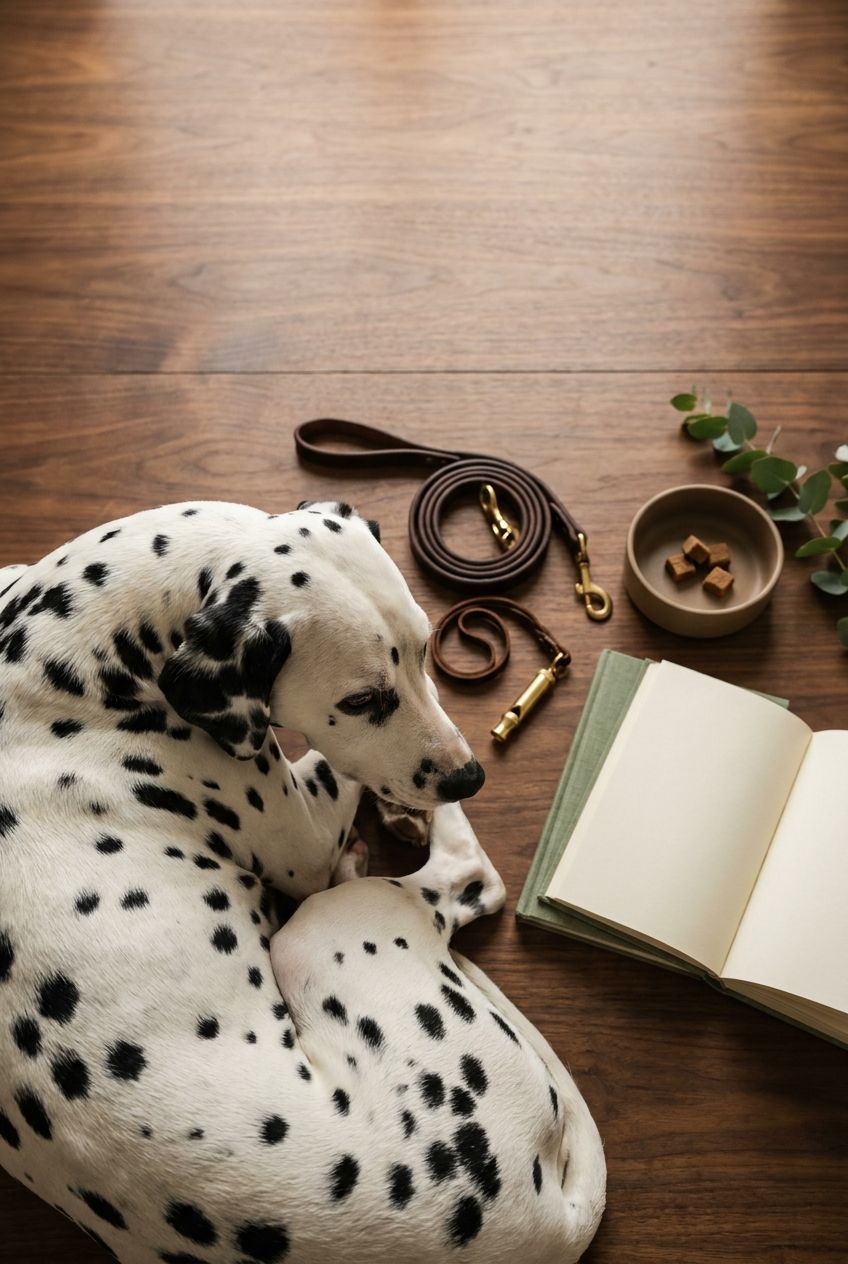
The Gear You Need Before Day One: A $100 Starter Kit
You do not need a pile of gadgets. You need five specific items, and buying them before the puppy or dog arrives saves you from improvising bad habits.
- A front-clip harness ($25 to $40): The Blue-9 Balance Harness or the 2 Hounds Design Freedom No-Pull Harness reduces pulling without choking the neck. Dalmatians can have sensitive throats, so skip prong and choke collars.
- A 6-foot standard leash ($12 to $20): Leather or flat nylon, not retractable. Retractables teach the dog that pulling extends the leash.
- A 30-foot long line ($15 to $25): Biothane material is waterproof and does not tangle. This is your recall safety net.
- Training treats ($8 to $15 per bag): Zuke’s Mini Naturals or Wellness Soft Puppy Bites. Pea-sized or smaller, roughly 3 to 5 calories each.
- A treat pouch ($10 to $15): Keeping rewards at hip level makes your timing fast enough to matter.
Success looks like this: a harness that fits with two fingers of space under every strap, and a pouch loaded with at least 30 treats before every session.
But what if your dog refuses treats? Try freeze-dried liver or small cubes of cooked chicken breast. Most Dalmatians will work for real meat even when kibble bores them.
How to Teach Sit, Down, and Stay in 10 Minutes a Day
Keep sessions short. Dalmatians learn best in bursts of 5 to 10 minutes, two or three times daily. Ending while the dog still wants more builds enthusiasm for the next round.
Sit: Ready in 3 to 5 Days
- Hold a treat at the nose. Let the dog sniff it but not grab it. Success: eyes locked on your hand.
- Raise your hand slowly over the head. The nose goes up and the rear drops. The instant the bottom touches the floor, say “Yes!” and deliver the treat.
- Add the word “Sit” after 5 to 10 successful repetitions. Say it just before the motion, not during.
- Fade the lure. Use an empty hand with the same motion, then reward from the pouch with the other hand.
If your dog jumps for the treat, you are holding it too high. Lower it and move slower.
Down: Ready in 5 to 7 Days
From a sit, lower a treat straight down between the front paws, then slide it forward along the floor. Reward the moment the elbows touch the ground. If the dog stands up instead, practice on a slippery floor or sit beside a low table and lure under it.
Stay: Build the Three Ds
Stay is built on duration, distance, and distraction, and you raise only one at a time. Start with a 3-second stay at 1 foot away, then return and reward. Add 2 seconds at a time. When the dog holds for 30 seconds at 6 feet in a quiet room, only then introduce distractions like a bouncing ball. If the dog breaks the stay, calmly reset with no scolding and make the next attempt easier.
Leash Manners: How to Stop Pulling in 3 Weeks
A Dalmatian that pulls on leash is not being dominant. It is simply moving at its natural speed, which is faster than yours. The fix is teaching that a loose leash moves forward and a tight leash stops everything.
The Stop-and-Go Method
- Clip the leash to the front ring of the harness. This turns the dog sideways when it pulls.
- Walk. The moment the leash tightens, stop completely. Plant your feet and do not move.
- Wait for slack. The dog will turn around or step back. Mark with “Yes!” and reward at your left thigh.
- Resume walking. Repeat every time tension appears. Expect 20 to 40 stops on the first walks. That is normal.
Success looks like 10 steps in a row with a leash shaped like a smile (a J-curve) rather than a straight line.
But what if the dog drags you to the end of the leash and ignores the stop? Turn and walk the other direction instead. The change in direction costs the dog its destination and teaches it to track you.
Practice in a quiet driveway for the first week before moving to busier streets. Expect 2 to 3 weeks of consistent practice before the walk feels pleasant.
The Recall Recipe: Teach “Come” That Works Off Leash
Recall is the most important cue you will ever teach and the one most owners ruin. The classic mistake is calling the dog to end the fun, like leaving a park or starting a bath. After a few repetitions, “Come” predicts bad news, and your Dalmatian learns to ignore it.
Build a Recall Worth Running For
- Pick a unique word. Use “Here!” or a whistle (an Acme 211.5 whistle costs about $8). Reserve it for recall only.
- Start indoors, 6 feet away. Say the word once in a bright voice. When the dog arrives, deliver 5 treats in a row, one at a time.
- Move to the yard on the 30-foot long line. Let the dog wander to the end, call once, and reward heavily. If the dog ignores you, gently reel the line in and reward on arrival.
- Add distractions slowly. Over 6 to 8 weeks, practice at the park, always on the long line.
Use high-value rewards for recall: hot dog pieces, cheese cubes, or a game of tug. If the dog runs to you and gets a boring kibble, it will weigh that choice next time against a squirrel.
But what if your Dalmatian bolts after a squirrel and ignores everything? That is exactly why the long line exists. Never let a Dalmatian off leash in an unfenced space until recall succeeds at least 9 out of 10 times with heavy distractions. For some dogs, that threshold is never reached, and that is acceptable. A securely fenced yard and long-line adventures still give excellent exercise.
Crate, Potty, and Chew Training: The First 12 Weeks Timeline
Puppies between 8 and 12 weeks old need structure. A Dalmatian puppy typically holds its bladder for about 1 hour per month of age, up to a limit, so an 8-week-old needs a bathroom trip every 2 hours.

- Crate size: Buy a 36-inch crate with a divider panel. The dog should stand, turn, and lie down but not have room for a bathroom corner.
- Potty schedule: Out first thing in the morning, after every meal (within 10 to 15 minutes), after naps, after play, and before bed. Reward within 3 seconds of the dog finishing outside, not when it comes back in.
- Night training: Expect 1 or 2 nighttime trips for the first 3 to 4 weeks. Set an alarm for 4 hours after bedtime.
- Chew outlet: Offer 3 to 4 approved items like a KONG Puppy toy stuffed with a teaspoon of peanut butter (xylitol-free) and frozen overnight.
Most Dalmatians are reliably house-trained between 4 and 6 months, though regressions at 5 to 7 months are common as adolescence kicks in.
But what if the dog cries in the crate? Do not release it during crying. Wait for a 5-second pause, then open the door. Starting with 5-minute sessions and building to hours prevents the crate from becoming a punishment.
Socialization Window: 5 Exposures a Week Before 16 Weeks
The critical socialization window closes around 14 to 16 weeks. During this time, your puppy builds lifelong opinions about the world. Dalmatians that miss it can develop fearfulness or reactivity, both of which are harder to fix later.
Aim for at least 5 new experiences per week, each lasting 5 to 10 minutes and ending on a positive note. These can include:
- Surfaces: grass, gravel, tile, metal grates, wobble boards
- Sounds: vacuum cleaner, doorbell, thunder recordings at low volume, skateboards
- People: hats, beards, umbrellas, children (supervised), people in uniforms
- Dogs: only vaccinated, calm adult dogs until your puppy completes its vaccine series
Check with your vet about when to start puppy classes. Many programs allow enrollment after the first round of vaccines, typically around 8 to 10 weeks, with the second round at 12 weeks.
Pair every new thing with treats. If the puppy freezes or backs away, increase distance and let it approach on its own. Forcing contact builds fear instead of confidence.
Which Training Method Fits Your Dalmatian? A Side-by-Side Comparison
Not every method suits every owner. Here is how the main options compare for Dalmatians specifically.
| Method | Typical Cost | Time to Reliable Basics | Best For |
|---|---|---|---|
| DIY with positive reinforcement | $100 to $200 (gear and treats) | 10 to 14 weeks | Owners who can train daily and want a strong bond |
| Group puppy class | $120 to $250 for 6 to 8 weeks | 8 to 12 weeks | First-time owners who need socialization and coaching |
| Private trainer | $75 to $150 per session | 4 to 8 weeks | Dogs with reactivity, jumping, or specific problems |
| Board-and-train | $1,500 to $4,000 for 2 to 4 weeks | 2 to 4 weeks (plus owner follow-through) | Busy households, but only with a reputable, force-free facility |
My recommendation: start with a group class plus daily DIY practice. It is the cheapest way to get coaching, socialization, and consistency. Choose a private trainer if your Dalmatian shows fear or aggression, and approach board-and-train with caution. Ask exactly what tools and corrections they use, and walk away from anyone who relies on shock collars or prong collars with a sensitive breed.
5 Mistakes That Wreck Dalmatian Obedience (And the Fixes)
These errors show up in almost every struggling Dalmatian household. Fix them early and progress speeds up dramatically.
- Training only when the dog is wound up. A dog with pent-up energy cannot focus. Fix: run a 15 to 20 minute fetch or jog before every session.
- Repeating cues. Saying “Sit, sit, SIT” teaches the dog that the first two do not count. Fix: say it once, wait 3 seconds, and if nothing happens, use a lure to help and reward.
- Skipping mental work. Physical exercise alone creates a fitter dog with the same bad habits. Fix: add 10 minutes of puzzle feeders, scent games, or trick training daily. Hide 10 treats around the room and cue “Find it.”
- Using punishment or yelling. Dalmatians shut down or become wary when scolded. Fix: interrupt the unwanted behavior calmly, redirect to a cue you have taught, and reward that instead.
- Allowing inconsistency across family members. If one person lets the dog on the couch and another does not, the dog learns the rule depends on who is watching. Fix: write 5 house rules on the fridge and have everyone use the same cue words.
Fixing even two of these typically cuts training time by weeks.
“But What If…?” Answers to the Toughest Dalmatian Training Objections
Every owner hits a wall. Here are the scenarios that trip people up most.
What if my Dalmatian is deaf?
Roughly 30 percent of Dalmatians have some hearing loss, and about 8 percent are bilaterally deaf (deaf in both ears). Deaf Dalmatians are fully trainable. Swap verbal cues for hand signals, use a vibrating collar (set to the lowest vibration, never a shock), and a flashing flashlight to get attention. A BAER test at 5 to 6 weeks confirms hearing status.
What if my adult Dalmatian is 3 years old and untrained?
Adult dogs learn just as well as puppies, and sometimes faster because their attention spans are longer. Start from the basics, expect 6 to 8 weeks to see strong progress, and focus on managing exercise first.
What if the jumping will not stop?
Dalmatians jump because it worked once. Turn your back and fold your arms the moment the paws leave the floor, then reward all four paws down. Ask visitors to do the same. Teach “Sit” as the greeting. Expect 2 to 4 weeks of consistent responses.
What if my dog barks or destroys things when alone?
This signals separation distress. Build alone time in 2-minute increments, add a frozen stuffed KONG, and consider a vet consult if the dog self-injures or drools heavily. A certified behaviorist (look for CAAB or DACVB credentials) can create a plan.
Your First 7 Days: A Concrete Action Plan
Do not wait for a perfect time. Block out 10 minutes tomorrow morning and run this exact sequence, then repeat daily for a week.
Day 1 to 2: Teach “Sit” with a lure, 10 repetitions twice a day. Day 3 to 4: Add “Down” and fade the lure to a hand signal. Day 5 to 6: Practice 3-second stays and one 5-minute loose-leash walk in your driveway. Day 7: Record a 60-second video of your dog performing all three cues, then compare it to a video of Day 1 to see your progress.
Tonight, load a treat pouch with 30 pea-sized treats and set it beside your front door. When the pouch is within reach, training happens. When it is in a drawer, it does not.