Master Obedience Training with Wirehaired Pointing Griffons: The Complete Guide
Your Wirehaired Pointing Griffon just blew past a “sit” command to stalk a squirrel three yards away, and you’re wondering if you bought a dog or a furry tornado with a nose. Here’s the truth: Griffons are among the most trainable gundogs in existence, but only if you work with their hardwired hunting instincts instead of against them. This guide breaks down exactly how to master obedience training with Wirehaired Pointing Griffons using the same methods field trainers use to produce dogs that hunt hard and listen even harder.
Why Wirehaired Pointing Griffons Are Different From Other Sporting Breeds
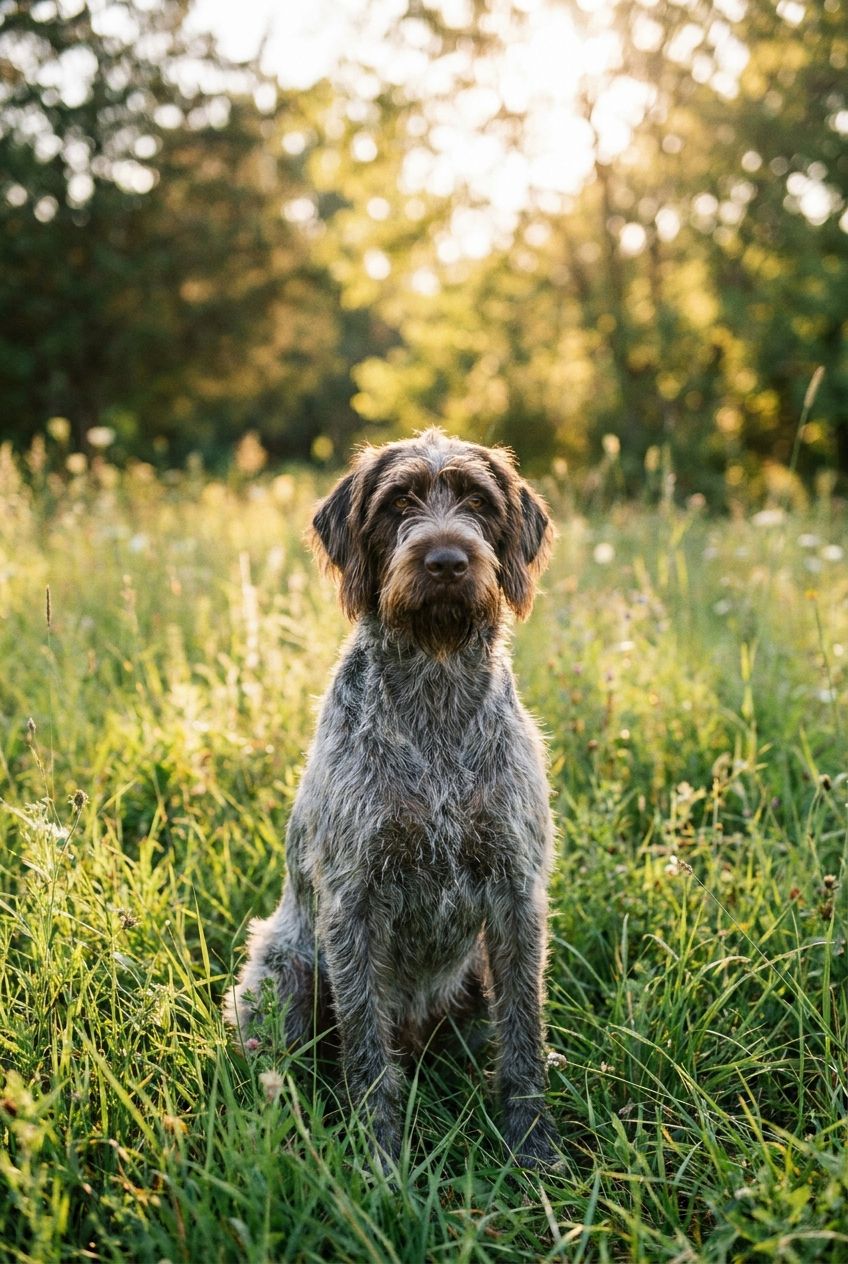
Developed in the 1870s by Dutch breeder Eduard Korthals, the Wirehaired Pointing Griffon was engineered for one job: finding and pointing game in brutal terrain, then walking calmly beside the hunter afterward. That dual nature is baked into every Griffon you’ll ever train.
The Numbers That Matter
- Weight: 50-70 lbs (males), 35-50 lbs (females)
- Height: 20-24 inches at the shoulder
- Energy requirement: 60-90 minutes of vigorous activity daily, minimum
- Working IQ: Ranks in the top 20% of AKC sporting breeds for problem-solving speed, but scores lower on “obedience on first command” compared to Labs or Goldens because they’re bred to think independently in the field
This combination — high intelligence plus independent decision-making — means Griffons get bored with repetitive drilling faster than a Golden Retriever will. Five identical “sit” reps in a row and you’ll watch the enthusiasm drain out of their eyes. Vary the commands, vary the location, and you’ll keep engagement high.
Master Obedience Training with Wirehaired Pointing Griffons: Building the Foundation (Weeks 8-16)
The window between 8 and 16 weeks is the single highest-leverage period you’ll ever get with this breed. Socialization and foundational obedience laid down here will save you months of remedial work later.
Week-by-Week Breakdown
- Weeks 8-10: Name recognition and hand-target training. Goal: dog orients to name within 1 second, 8 out of 10 times.
- Weeks 10-12: Sit, down, and crate-comfort. Sessions capped at 5 minutes, 3x daily.
- Weeks 12-14: Loose-leash walking on a flat buckle collar; introduce “leave it” using low-value distractions (a piece of kibble on the floor, not a toy).
- Weeks 14-16: Recall foundation in a fenced yard using a 15-foot long line (Mendota Check Cord, roughly $22-28) so you can physically enforce the command without chasing the puppy.
Skip this window or delay it past 16 weeks, and you’re not just behind schedule — you’re fighting against a developing fear period that makes new experiences (traffic, strangers, other dogs) genuinely harder to process. Data from guide-dog training programs shows dogs socialized before 14 weeks require roughly 40% fewer corrective sessions as adults.
Core Obedience Commands: Step-by-Step Protocols
Griffons respond best to marker-based training (clicker or verbal marker) paired with high-value rewards. Here’s the exact protocol I use for the five non-negotiable commands.
1. Sit
Hold a treat at nose height, move it back over the head until the rear drops. Mark the instant the rear touches the ground, then reward. Repeat 8-10 times per session, 2-3 sessions daily. Most Griffon puppies reliably sit on cue within 3-5 days.
2. Down
From a sit, lower the treat straight to the floor between the paws. Griffons often “play bow” instead of lying flat at first — wait for full elbow contact with the ground before marking. Expect 7-10 days to reliability.
3. Stay
Build duration before distance. Start with 3 seconds, add 2-3 seconds per successful rep. By week 3, most Griffons can hold a stay for 30 seconds with you standing 10 feet away.
4. Recall (“Come”)
This is the command that saves lives around traffic and prevents a half-mile chase through the woods after a pheasant scent. Use a 30-foot long line until recall is 95% reliable off-leash in low-distraction settings — typically 6-8 weeks of daily practice.
5. Heel
Griffons pull hard when scenting. Teach heel using the “stop and reset” method: the moment the leash tightens, stop walking entirely. Most owners see a 50% reduction in pulling within two weeks of consistent stopping.
Leash Training and Managing the Hunting Drive
The Griffon’s nose is its downfall in obedience work. A dog that ignores you the second it catches bird scent isn’t being stubborn — it’s doing exactly what 150 years of selective breeding designed it to do.
Practical Fixes
- Pattern training: Practice recall and heel in fields with planted scent (a feather or wing-wing dummy) so the dog learns commands still apply even with birds present.
- Premack Principle: Require a sit or down before releasing the dog to “go sniff” as a reward. This teaches the dog that obedience unlocks the very freedom it wants.
- Controlled exposure: Start distraction training at 20+ feet from the trigger, not right next to it. Close the distance only after 90% success rate.
A 30-foot check cord remains the single best investment for this stage — it lets you enforce recall around real distractions without risking a bolt into traffic.
Common Training Mistakes (And How to Fix Them)
Griffons are sensitive dogs — they were never bred to withstand harsh handling, and heavy-handed correction backfires fast. Here are the mistakes I see most often.
- Using harsh verbal or physical corrections. Griffons shut down or become avoidant rather than more obedient. Fix: switch to marker-based reward training and use “no reward” (simply withholding the treat) instead of punishment for mistakes.
- Training a tired or under-exercised dog. A Griffon with pent-up energy cannot focus. Fix: burn off physical energy with a 20-30 minute run or retrieving session before any obedience work.
- Skipping distraction-proofing. Commands that work perfectly in the living room fall apart at the dog park. Fix: practice the “3 D’s” — Duration, Distance, Distraction — incrementally, never more than one variable increased at a time.
- Inconsistent household rules. If one family member allows counter-surfing and another doesn’t, the dog receives mixed signals. Fix: write down house rules and make sure every family member enforces them identically.
- Ending sessions on a failure. The dog associates training with frustration. Fix: always end on an easy, successful rep, even if it means backing up to a simpler command.
- Overusing treats without fading them. Some owners never transition off constant food reward. Fix: move to a variable reinforcement schedule (rewarding every 2nd or 3rd correct rep) once the behavior is 80% reliable.
- Starting e-collar training too early. Introducing an e-collar before 6 months, or before the dog has a rock-solid understanding of the command, creates confusion and anxiety. Fix: wait until at least 6 months and only after the dog reliably performs the command on a long line first.
Training Tools Comparison: What Actually Works
Not every training method suits every Griffon. Here’s how the major approaches stack up based on cost, learning curve, and effectiveness specifically for this breed.
| Method | Approx. Cost | Learning Curve | Best For | Griffon Effectiveness |
|---|---|---|---|---|
| Clicker Training | $8-15 (e.g., PetSafe Clik-R) | Moderate (owner must learn timing) | Puppies, precision commands | Excellent — Griffons respond fast to clear markers |
| Verbal Marker Only | Free | Low | Owners who want simplicity | Good, slightly less precise timing |
| Long Line (Check Cord) | $20-30 (Mendota 30ft) | Low | Recall, field distraction work | Excellent — essential for this breed |
| E-Collar | $150-300 (Garmin Delta, SportDOG) | High — requires proper training first | Advanced field obedience, off-leash reliability | Very effective after 6 months, risky if misused |
| Treat-Only Training | $10-20/month in treats | Low | Basic commands | Good short-term, weak without a transition plan |
Most successful Griffon owners combine a clicker for foundational work, a long line for field distraction training, and — only after 6 months of solid groundwork — an e-collar for off-leash reliability in hunting scenarios.
Advanced Obedience for Field-Ready Griffons
Once your Griffon has mastered the basics (usually by 6-8 months), you can layer in field-specific obedience that separates a well-mannered pet from a genuinely reliable hunting partner.
Whoa Command
Distinct from “stay,” the “whoa” command stops a dog instantly mid-stride, critical when a Griffon is approaching a point. Train this on a check cord starting at 8-10 months, using gentle collar pressure paired with the verbal cue, released only when the dog stands still.
Steady to Wing and Shot
This teaches the dog to hold its point even when a bird flushes and a shot is fired — a process that typically takes 3-4 months of consistent, low-pressure repetition using training pigeons or a launcher (Dogtra or D.T. Systems launchers run $150-250).
Off-Leash Reliability Benchmarks
- 85%+ recall success rate around low-level distractions by 8 months
- 75%+ recall success rate around birds/game scent by 12 months
- Reliable “whoa” on point by 12-14 months for dogs started on schedule
What If Scenarios: Troubleshooting Real Problems
“What if my Griffon completely ignores me when it catches bird scent?”
This is normal, not a training failure. Go back to check-cord work in a bird-scented environment and rebuild recall from a shorter distance (10-15 feet) before increasing difficulty.
“What if training regresses during adolescence (6-18 months)?”
Almost every Griffon has a regression phase, often triggered by hormonal shifts. Expect a 20-30% temporary dip in obedience reliability. Stay consistent, shorten sessions, and avoid introducing new commands during this window.
“What if I don’t have access to fields or hunting land?”
You can simulate scent work using bird wings (available from hunting suppliers, $10-15 each) frozen and thawed for scent sessions in your backyard, or enroll in a local AKC hunt-test training group.
“What if my Griffon is food-motivated but also overweight?”
Switch to a lower-calorie training treat (freeze-dried liver cut into pea-sized pieces) and reduce the dog’s regular meal portions by the equivalent number of training calories consumed — typically a 10-15% reduction in kibble volume during heavy training weeks.
Weekly Training Schedule Template
Consistency beats intensity. Here’s a realistic weekly structure that fits into most owners’ schedules while still producing real progress.
- Monday/Wednesday/Friday: 15-minute obedience session (sit, down, stay, heel) plus a 30-minute physical exercise block
- Tuesday/Thursday: Recall and distraction-proofing in a new environment (park, trail, friend’s yard)
- Saturday: Field/scent work session, 30-45 minutes
- Sunday: Rest day with light play, no formal training — critical for preventing burnout in high-drive dogs
Owners who follow a structured schedule like this typically report full basic obedience reliability (sit, down, stay, come, heel) within 10-12 weeks, compared to 5-6 months for owners who train inconsistently.
Conclusion: Your Next 30 Days
Stop treating your Griffon like a generic family dog and start treating it like the working gundog it was bred to be — that single mindset shift changes everything about how training clicks. This week, invest in a 30-foot check cord and a clicker if you don’t already have them, and commit to three 10-minute sessions daily rather than one long, frustrating one. Track your dog’s recall success rate for two weeks; if it’s below 70% around distractions, go back to shorter distances before pushing further. In three months, revisit this guide’s benchmarks — if you’re hitting 85% reliability on core commands, you’re ready to move into field-specific work like “whoa” and steady-to-wing training. The dogs that end up rock-solid in the field all started with owners who respected the breed’s intelligence and independence instead of fighting it.