Potty-Training Your Dalmatian Puppy: A Step-by-Step Guide That Works in 4 to 8 Weeks
Potty-Training Your Dalmatian Puppy: A Step-by-Step Guide That Works in 4 to 8 Weeks
Dalmatians are one of the few breeds where potty training is not just about your carpet. It is also about your dog’s kidneys, because every Dalmatian carries a genetic quirk that makes bathroom habits a health issue. This guide to potty-training your Dalmatian puppy gives you a day-by-day system, exact schedules, and the breed-specific details most generic puppy guides skip.
The good news: Dalmatians are smart, food-motivated, and clean by instinct. Most puppies who follow a consistent routine are reliable inside the house within 4 to 8 weeks. The bad news: they are also stubborn, high-energy, and quick to learn bad habits if you give them a week of loose rules.
Why Potty-Training a Dalmatian Is Different From Other Breeds
Three breed traits change how you train, and ignoring them is the number one reason owners struggle.

The urate problem
Nearly all Dalmatians have a gene variant that stops them from fully converting uric acid into allantoin, the soluble waste product other dogs excrete. Uric acid can crystallize into bladder stones, which affect roughly 25 to 30 percent of male Dalmatians in some studies. Stones are far more dangerous in males because their narrow urethra can block completely, which is a veterinary emergency.
What this means for training: your puppy needs frequent chances to empty their bladder, constant access to fresh water, and never any “hold it” lessons that stretch beyond their physical limit. Punishing a pup for urgency is not just ineffective here, it can be harmful.
Energy and intelligence
Dalmatians were bred to run alongside carriages for miles. A bored, under-exercised puppy will have accidents out of excitement, anxiety, or plain mischief. A 10-minute play session before each crate period burns off enough energy to improve success rates noticeably.
Sensitivity
Many Dalmatians are sensitive to harsh tones. Yelling at an accident often teaches them to hide when they need to go, which means they will sneak behind the couch instead of signaling you. Calm, consistent, reward-based training works better with this breed than correction-heavy methods.
What to Buy Before Day One (With Exact Sizes and Prices)
Set up before your puppy arrives. Scrambling for supplies at 6 a.m. after the first accident is how bad habits start.
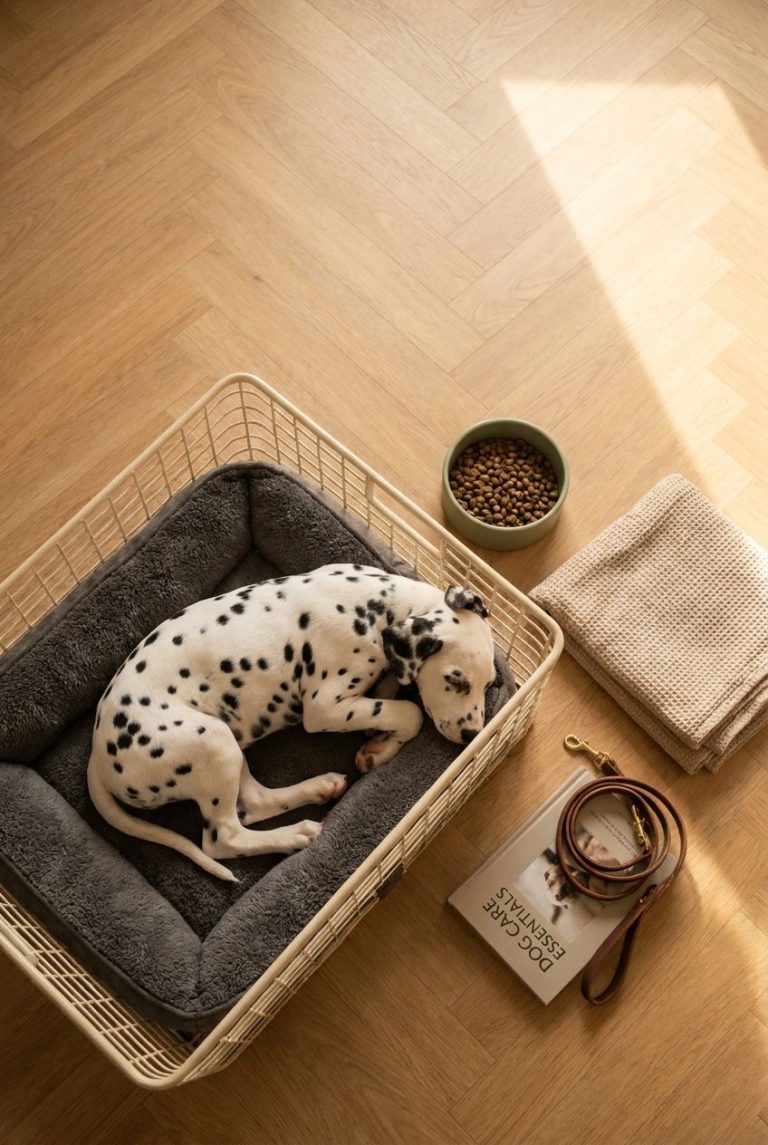
- A crate sized for the adult dog, with a divider. Dalmatians reach 19 to 24 inches at the shoulder and 45 to 70 pounds. Buy a 42-inch crate with a divider panel (MidWest Life Stages 42-inch runs about $55 to $70). Block off the extra space so your puppy has just enough room to stand, turn, and lie down. Too much space lets them pee in one corner and sleep in the other.
- An enzymatic cleaner. Nature’s Miracle or Rocco and Roxie ($15 to $25 per bottle) break down the proteins in urine. Regular cleaners leave a scent trail that pulls your puppy back to the same spot. Do not use ammonia-based products, since ammonia smells like urine to dogs.
- High-value treats. Use tiny, pea-sized pieces of boiled chicken, string cheese, or Zuke’s Mini Naturals (about $6 for a 16 oz bag). Skip high-purine treats like liver, organ meats, and sardines, which are risky for urate stone formation.
- A 6-foot leash and a collar or harness. A plain nylon leash is fine. You will use it for every outdoor trip so your puppy learns that outside means business.
- Two stainless steel water bowls. Keep one in the crate area during the day (but not overnight for young puppies) and one in a main living space. Aim to encourage drinking, not restrict it.
- A treat pouch and a timer. Your phone timer works. You will set it often.
Total startup cost: roughly $130 to $190. Skip the pee pads for now. They teach your puppy that indoors is an acceptable bathroom, which makes the later switch to outdoors harder.
The Daily Schedule That Prevents Accidents Before They Happen
Puppies cannot hold their bladder as long as most people assume. A common rule of thumb: one hour per month of age, plus one. A 2-month-old can manage about 3 hours at most, and that is a stretch when they are awake and playing.
For a Dalmatian, shade shorter. Take your puppy out at these moments, every single time:
- Immediately after waking up (from naps and overnight), within 1 to 2 minutes
- 10 to 20 minutes after eating or drinking, when digestion kicks in
- After play sessions, because excitement stimulates the bladder
- Before crating and right after leaving the crate
- Every 60 to 90 minutes while awake for puppies under 12 weeks
A sample day for an 8-week-old puppy
6:30 a.m. wake up and outside. 6:45 breakfast. 7:05 outside. 7:30 to 8:30 supervised play, then outside. 8:45 crate nap. 10:30 outside right away. Repeat this pattern: outside, short activity, outside, nap. Lunch and dinner follow the same food-then-outside rule. Last water goes down about 2 hours before bed, and the final outing happens right before lights out.
But what if my work schedule does not allow outings every 90 minutes? Then you need help. Hire a dog walker ($15 to $25 per visit), ask a neighbor, or use a daytime playpen with a defined potty area. Do not leave an 8-week-old alone for 6 hours and expect success.
How to Teach Your Puppy to Pee on Command in 5 Steps
A verbal cue turns potty breaks from a guessing game into a 2-minute task. This is especially useful in rain, snow, or when you are running late.
- Pick one spot and one phrase. Choose a patch of yard 20 to 30 feet from your door and a short cue like “go potty.” Success looks like your puppy sniffing the same area each trip.
- Walk to the spot on leash. Stand still and stay boring. Do not play or chat. If nothing happens in 5 minutes, go back inside, crate for 10 minutes, then try again. (If your puppy is mouthing the leash or bouncing around, they are distracted, not ready.)
- Say the cue as they begin to go. Say it quietly, just once or twice, while they are mid-stream. You are linking the word to the action, not commanding it yet.
- Reward within 3 seconds of finishing. Treat and praise right there at the spot, not back at the door. Delayed rewards teach “come inside” instead of “pee outside.”
- Add a short celebration walk. After they finish, play for 5 minutes or walk the block. Otherwise, puppies learn that going potty ends the fun and start holding it to stay outside longer.
Within about 10 days of consistent practice, most Dalmatian puppies start squatting when they hear the cue. Once the response is reliable, say the cue before they start and reward the result.
Crate Training for Potty Success: Timing, Nights, and Realistic Limits
A crate works because dogs avoid soiling where they sleep. But it only works if the crate is the right size and the time inside is realistic.

Daytime crate limits by age
At 8 weeks, cap crate time at 1 to 2 hours. At 12 weeks, 3 hours. At 16 weeks, 4 hours. At 6 months, up to 5 or 6 hours, though daytime stretches should still be the exception. These numbers apply to waking hours; sleeping puppies hold it longer.
Handling the night shift
Expect to wake once or twice per night until about 14 to 16 weeks. Set an alarm for 4 to 5 hours after bedtime at first. Take your puppy out on leash, no play, no talking, then straight back to the crate. Gradually push the alarm later by 30 minutes every few nights.
Because of the urate issue, do not withhold water to make nights easier. Remove water about 2 hours before bed, but give a small drink if your puppy seems thirsty. Healthy hydration dilutes urine and reduces crystal formation.
But what if my puppy cries in the crate at night? Distinguish between “I am bored” and “I need to go.” If it has been 4 or more hours, take them out. If it was 90 minutes ago, wait 10 minutes of calm. Taking them out every time they whine teaches them that crying opens the door.
How to Fix Accidents Without Making Things Worse
Accidents are data, not disasters. Each one tells you the schedule had a gap. What you do in the next 60 seconds matters more than the accident itself.
If you catch your puppy mid-squat, say “oops” in a neutral voice, scoop them up, and carry them outside. If they finish outside, reward immediately. If you find a puddle after the fact, say nothing. Dogs cannot connect a scolding to something that happened 30 seconds ago, let alone 5 minutes ago.
Clean the spot using an enzymatic cleaner, saturating it fully and letting it air dry for 10 to 15 minutes. Blot, do not rub, and do not use steam cleaners, which can set odors into carpet fibers.
Never rub your puppy’s nose in it. Never yell. With a sensitive breed like the Dalmatian, you may create a dog who hides to pee, which is much harder to fix than a dog who simply does not know the rules yet.
Track accidents in a notes app for one week. Note the time, what happened 30 minutes earlier, and your puppy’s activity. Patterns jump out fast. Many owners discover that nearly all accidents happen within 20 minutes of a meal, which means the post-meal outing needs to be quicker.
Potty-Training Timeline: What to Expect Week by Week
Progress is not linear. Puppies often regress around 4 to 5 months when adolescence hits, so do not panic if week 6 looks worse than week 4.
| Age / Week | Typical Outdoor Frequency | Max Crate Time (Daytime) | What Success Looks Like |
|---|---|---|---|
| 8 to 10 weeks (Week 1 to 2) | Every 60 to 90 minutes | 1 to 2 hours | 2 to 3 accidents per day is normal |
| 10 to 12 weeks (Week 3 to 4) | Every 90 minutes to 2 hours | 2 to 3 hours | 1 accident per day, begins signaling at door |
| 3 to 4 months (Week 5 to 8) | Every 2 to 3 hours | 3 to 4 hours | 0 to 2 accidents per week |
| 4 to 6 months | Every 3 to 4 hours | 4 to 5 hours | Reliable with brief regression possible |
| 6+ months | Every 4 to 6 hours | 5 to 6 hours | Consistent; ready for more freedom |
Do not give free run of the house until your puppy has gone 4 to 6 consecutive weeks without an accident. Expand access one room at a time, starting with the kitchen or living room, and keep doors closed elsewhere.
Potty-Training Methods Compared: Crate, Pads, and Supervised Freedom
Not every method suits every home. Here is how the three most common approaches stack up for a Dalmatian puppy specifically.
| Method | Speed to Reliability | Effort Required | Risk for Dalmatians | Best For |
|---|---|---|---|---|
| Crate + scheduled outings | 4 to 8 weeks | High at first, then low | Low, if outings are frequent enough | Most households; recommended default |
| Pee pads | 8 to 16 weeks (plus a second transition) | Moderate | Medium: confuses indoor/outdoor rules | High-rise apartments, owners with mobility limits |
| Supervised freedom (leash tether, no crate) | 6 to 10 weeks | Very high, constant watching | Medium: accidents spike when attention slips | Work-from-home owners who dislike crates |
Our recommendation: use crate plus scheduled outings. It is the fastest, cheapest, and most reliable for a high-energy breed. Choose pads only if you live above the 10th floor and cannot reach the ground quickly, and plan to phase them out by moving the pad closer to the door, then outside, over 2 to 3 weeks.
5 Common Mistakes That Slow Dalmatian Potty-Training
- Giving too much freedom too soon. A puppy who goes 5 days without accidents is not trained; they are lucky. Keep them within 15 feet of you or in the crate until week 6 at minimum. Fix: use baby gates and a tether leash clipped to your belt.
- Restricting water to reduce accidents. This is risky for Dalmatians because concentrated urine encourages urate crystals. Fix: keep water available all day and manage the schedule around it.
- Skipping the post-meal outing. Most puppies need to poop within 5 to 30 minutes of eating. Fix: set a timer for 10 minutes after every meal.
- Using the same door inconsistently. If you sometimes use the back door and sometimes the front, your puppy never learns where to signal. Fix: pick one door and hang a set of bells at nose height. Ring them yourself, then reward, every outing.
- Feeding a high-purine diet. Foods heavy in organ meats, certain fish, and some dog foods can raise uric acid output. Fix: ask your vet about a low-purine diet such as Hill’s Prescription Diet u/d or a quality, lower-protein adult formula, and avoid feeding table scraps.
Your Questions Answered: Regression, Rain, and “What If It Is Not Working?”
What if my puppy was doing great and suddenly regressed?
Regression at 4 to 6 months is common and usually temporary. First rule out a urinary tract infection (UTI): if your puppy is peeing small amounts frequently, straining, or has blood in the urine, call your vet the same day. For Dalmatians, this can signal stones, not just a training lapse. If the vet clears them, go back to a puppy schedule for 2 weeks.
What if my puppy refuses to pee in the rain or cold?
Dalmatians have thin, short coats and dislike wet weather. Use a covered area if possible, bring an umbrella, and put a coat on in cold temperatures below 45 degrees Fahrenheit. Keep the trip short and reward heavily.
What if my puppy only goes inside after a long walk?
This is a classic pattern: outside is too exciting, so they wait until they are back in a calm space. Fix it by staying at the potty spot for up to 5 minutes before any walking begins. Walks become the reward for finishing business, not a replacement for it.
What if the problem continues past 6 months?
Book a vet visit for a urinalysis (typically $40 to $80). Persistent accidents beyond 6 months can indicate a medical issue, especially in this breed. If the vet finds nothing, consult a certified trainer through the CCPDT directory; 2 to 3 sessions ($60 to $120 each) often resolve it.
Is it ever too late to start?
No. Adult Dalmatians adopted from shelters can be retrained using the same schedule, though the timeline may stretch to 8 to 12 weeks. Treat them as a puppy for the first two weeks, regardless of age.
Your First 7 Days: A Practical Starting Plan
Do not wait for the perfect moment. Tonight, before your puppy goes to sleep, clear a corner of the kitchen, set up the crate with the divider in place, and write your outdoor schedule on a sticky note on the fridge. Tomorrow morning, take your puppy out within 60 seconds of waking, say your cue word, and carry treats in your pocket.
For the first 7 days, track every outing and accident on a single page: time, result, and treat given. By day 7, you will see your puppy’s natural rhythm, usually clustering around meals and naps. Adjust your schedule to match, schedule a vet visit to discuss a low-purine diet and baseline urinalysis, and start planning the next skill: calling your puppy to the door when they need to go.