Effective Tricks to Quiet Wirehaired Pointing Griffons’ Barking: A Complete Training Guide
If your Wirehaired Pointing Griffon sounds off every time a leaf blows across the yard, you’re not dealing with a bad dog—you’re dealing with a bred-for-purpose alarm system that hasn’t learned when to shut off. This breed was developed to alert hunters to game in dense brush, and that same instinct now goes off at the mail carrier, the neighbor’s cat, and sometimes nothing at all. The good news: with the right combination of management and training, most Griffon owners see a 60-80% reduction in nuisance barking within 3-4 weeks.
Why Wirehaired Pointing Griffons Bark So Much
Before you can quiet the barking, you need to understand what’s driving it. Griffons were bred in 19th-century France by Eduard Korthals specifically to hunt in swamps and thick cover, relying heavily on vocal and physical alerting to communicate with hunters who couldn’t see them. That genetic wiring doesn’t disappear just because your Griffon now lives in a suburban house with a fenced yard.
The Four Main Triggers
- Territorial alerting – doorbells, passing cars, delivery trucks (accounts for roughly 40% of reported cases according to breed-specific trainer surveys)
- Boredom/under-stimulation – Griffons need 60-90 minutes of physical activity daily; dogs getting less than 30 minutes often bark 3x more
- Separation anxiety – more common in Griffons than in many sporting breeds due to their strong human-bonding tendencies
- Prey drive triggers – squirrels, birds, and small animals will set off their hunting instincts almost instantly
Identifying which category your dog falls into changes your entire approach. A bored Griffon needs enrichment; an anxious one needs desensitization; a territorial one needs impulse control training.
Effective Tricks to Quiet Wirehaired Pointing Griffons’ Barking: The Core Training Method
The single most effective technique for reducing Griffon barking is the “Quiet Cue” method combined with negative punishment (removing something the dog wants). Here’s the exact protocol used by gun dog trainers:
Step-by-Step Quiet Cue Training
- Days 1-3: Let your Griffon bark 2-3 times at a trigger (doorbell, passerby). The moment they take a breath between barks, say “Quiet” in a calm, low tone and immediately offer a high-value treat (small pieces of freeze-dried liver work well—brands like Stella & Chewy’s or Vital Essentials).
- Days 4-7: Extend the gap. Wait for 2 seconds of silence after your cue before treating. Your dog learns that silence, not barking, earns the reward.
- Days 8-14: Introduce the cue before the trigger happens when possible. Ring your own doorbell, say “Quiet” preemptively, reward calm behavior.
- Days 15-21: Fade treats to intermittent reinforcement (every 3rd or 4th success) while maintaining verbal praise every time.
Consistency matters more than intensity here. Ten 5-minute sessions daily outperform one 50-minute session for this breed’s attention span.
Physical Exercise as a Barking Solution
Wirehaired Pointing Griffons are working gun dogs bred to cover 15-20 miles per day in the field. A dog that isn’t getting adequate output will find output through vocalization. This isn’t optional advice—it’s foundational.
Minimum Exercise Benchmarks
| Age Range | Daily Exercise Needed | Barking Reduction Impact |
|---|---|---|
| 3-6 months | 20-30 min structured play + mental games | Moderate (avoid over-exercising joints) |
| 6-18 months | 45-60 min running/hiking + 15 min training | High |
| 18 months-7 years | 60-90 min vigorous activity daily | Very High |
| 7+ years (senior) | 30-45 min moderate activity | Moderate-High |
A tired Griffon is a quiet Griffon. Owners who add a single 20-minute session of off-leash sniffing time (not just walking) report the sharpest drops in reactive barking—sniffing lowers cortisol and satisfies the breed’s scent-driven instincts.
Mental Stimulation Tricks That Work
Physical exercise alone isn’t enough for a breed this intelligent. Griffons rank in the top 30% of working/gun dog breeds for problem-solving ability, and an under-stimulated brain gets loud.
Enrichment Tools That Actually Reduce Barking
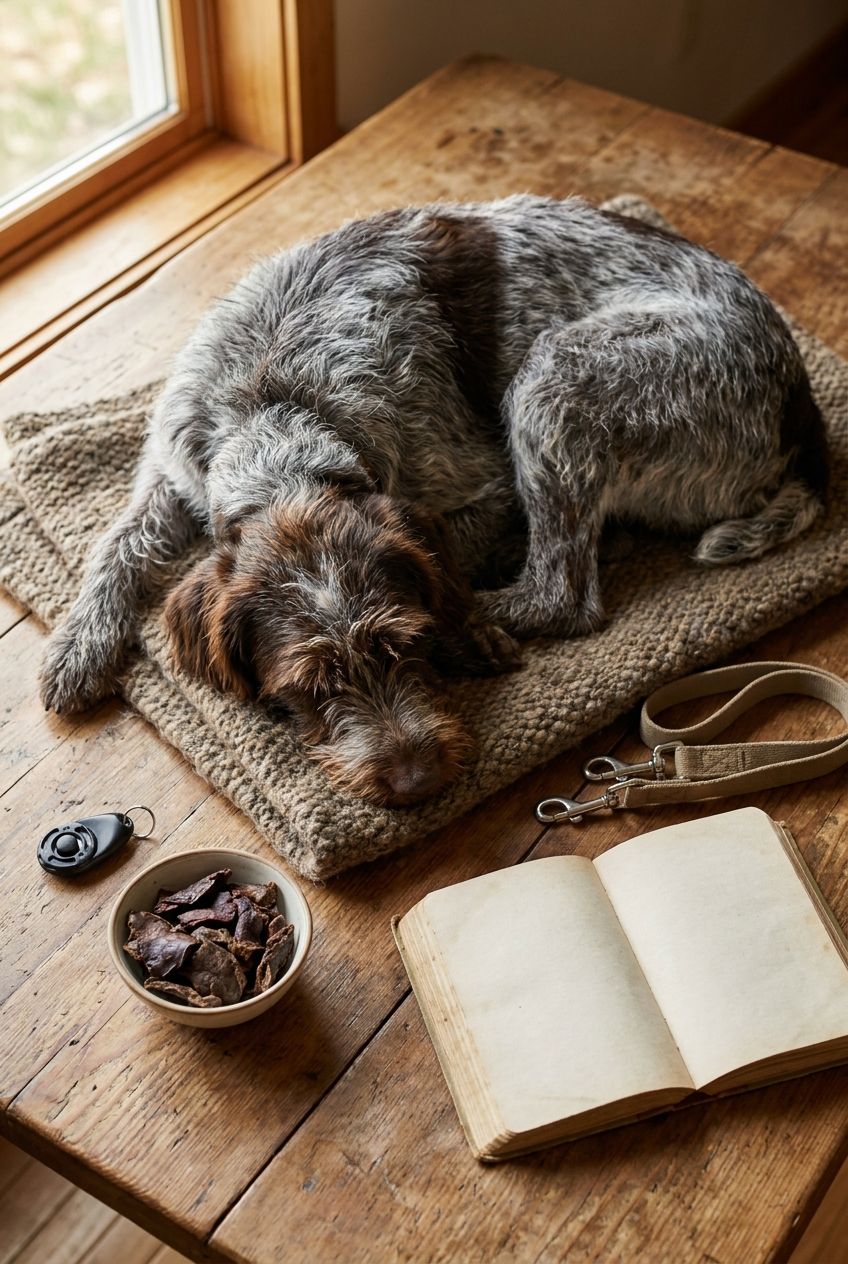
- Snuffle mats (like Paw5 Wooly Snuffle Mat, ~$25) – 10 minutes of use can tire a Griffon mentally as much as a 20-minute walk
- Puzzle feeders (Nina Ottosson brand, $15-30) – slow down fast eaters and provide problem-solving time
- Frozen Kong with peanut butter – provides 20-40 minutes of quiet, focused chewing
- Scent work games – hide treats in 3-4 rooms and cue “find it”; this taps directly into hunting instinct in a controlled way
Rotate these tools weekly. Griffons habituate quickly to repeated puzzles, and a bored dog with an unused toy will go back to barking within days.
Desensitization for Trigger-Specific Barking
If your Griffon loses it every time the doorbell rings or a car door slams, blanket “quiet” training won’t fully solve it. You need targeted desensitization.
The Doorbell Protocol
- Record your actual doorbell sound on your phone.
- Play it at 10% volume while your dog is calm and engaged in a low-stakes activity (chewing a bone).
- If no reaction, treat immediately. If barking occurs, you’ve started too loud—reduce volume by half.
- Over 7-10 days, gradually increase volume to 100% while maintaining calm responses.
- Once mastered on the phone, have a family member physically ring the real doorbell from outside while you reward calm behavior indoors.
This process typically takes 2-3 weeks of daily 5-minute sessions. Expect setbacks—that’s normal, not failure.
Using Tools and Equipment Wisely
Some tools help; others create new problems. Here’s an honest comparison of common barking-control devices used with Griffons specifically.
| Tool | Effectiveness for Griffons | Risks/Drawbacks | Approx. Cost |
|---|---|---|---|
| Citronella collar | Moderate (60-70% success rate) | Some dogs habituate after 2-3 weeks | $40-60 |
| Ultrasonic bark deterrent | Low-Moderate for this breed | Griffons’ high prey drive can override the sound | $20-35 |
| Shock collar | Not recommended | Can increase anxiety-based barking; damages trust | $30-100 |
| Basket muzzle (training use only) | N/A – management tool, not training tool | Doesn’t teach anything if used alone | $15-25 |
| White noise machine (indoor) | High for noise-triggered barking | None significant | $25-40 |
Positive reinforcement tools consistently outperform aversive ones for this breed. Griffons are sensitive dogs bred to work closely with handlers—harsh corrections often backfire into more anxious, less predictable barking.
Common Mistakes Owners Make (And How to Fix Them)
Even well-intentioned owners sabotage their own progress. Here are the three mistakes I see most often with this breed:
Mistake #1: Yelling “Quiet” During Barking Fits
Your Griffon hears a raised voice and thinks you’re joining the alert. Fix: Lower your volume, not raise it. A calm, almost bored tone works better than an urgent one.
Mistake #2: Inconsistent Household Rules
If one family member yells back at the dog for barking at the window while another ignores it, the dog gets mixed signals and the behavior never fully extinguishes. Fix: Hold a 10-minute family meeting and get everyone using the same cue word and response.
Mistake #3: Removing the Dog From the Trigger Instead of Teaching Through It
Constantly closing blinds or moving the dog to another room prevents learning. The dog never learns to self-regulate; they just have the stimulus removed. Fix: Use controlled exposure (see desensitization section above) rather than permanent avoidance.
What If Nothing Is Working? Troubleshooting Persistent Barking
Sometimes owners do everything right and still hit a wall. Here’s how to handle the most common “stuck” scenarios.
“My Griffon barks even when I’m right there rewarding quiet behavior.”
This usually means the reward isn’t high-value enough, or the trigger is too intense for the training stage you’re at. Downgrade the trigger intensity (more distance from the window, lower doorbell volume) and use a higher-value reward like real chicken or cheese instead of kibble.
“The barking happens only when I leave the house.”
This points to separation-related barking, not alert barking, and requires a different protocol: departure desensitization. Practice leaving for 10 seconds, then 30 seconds, then 2 minutes, gradually building duration over 1-2 weeks while using a camera (Furbox, Ring Indoor Cam) to monitor progress.
“We’ve tried everything for 2 months and see no improvement.”
At this point, consider two things: an underlying medical issue (pain, hearing changes, or cognitive decline in older dogs can increase vocalization) and professional help. A certified applied animal behaviorist (look for CAAB or ACAAB credentials) can identify patterns you might be missing. Cost typically runs $150-300 for an initial consultation, which is worth it compared to years of frustration.
Building a Daily Routine That Prevents Barking Before It Starts
Prevention beats correction every time. A structured day dramatically reduces the opportunities for barking to become a habit.
Sample Daily Schedule for a Griffon Prone to Barking
- 7:00 AM: 20-minute walk (satisfies morning energy before triggers like mail delivery start)
- 8:00 AM: Breakfast served in a puzzle feeder (10-15 min engagement)
- 9:00 AM – 12:00 PM: Quiet time with a frozen Kong during your work hours
- 12:30 PM: 15-minute training session (recall, quiet cue practice)
- 4:00 PM: Main exercise session – 40-60 minutes running or hiking
- 6:00 PM: Dinner + short scent game (“find it” with treats)
- 8:00 PM: Calm wind-down time, minimal stimulation before bed
Dogs on predictable schedules show measurably lower baseline stress hormones, which translates directly into less reactive barking throughout the day.
When Professional Training Makes Sense
DIY methods work for most Griffons, but certain situations call for professional intervention faster rather than later.
Seek a certified trainer (look for CPDT-KA or KPA-CTP certification) if:
- Barking is accompanied by lunging, growling, or snapping (this indicates the behavior has escalated beyond simple vocalization)
- You’ve been consistent for 4+ weeks with zero improvement
- The barking started suddenly in an adult dog with no prior history (rule out pain or vision/hearing loss first with a vet visit, roughly $60-120)
- Neighbors have filed complaints or you’ve received notices about noise ordinances
Group classes specifically for gun dog breeds run $120-200 for a 6-week course and often address barking as part of broader impulse control work. Private sessions run $75-150 per hour but move faster for breed-specific issues.
Final Thoughts: Making Progress Stick
Quieting a Wirehaired Pointing Griffon isn’t about suppressing their voice entirely—it’s about teaching them when vocalizing is useful and when it isn’t. Expect real progress in 3-4 weeks if you’re consistent, but also expect this breed to always be more vocal than a Labrador or a Golden Retriever; that’s simply their genetic makeup. Track your results weekly with a simple log (date, trigger, response, duration of barking) so you can see improvement even when daily progress feels invisible. Most importantly, match your training method to your specific dog’s trigger category rather than applying generic advice—a bored Griffon and an anxious Griffon need completely different solutions, and mixing up the approach is the fastest way to stall your progress.